
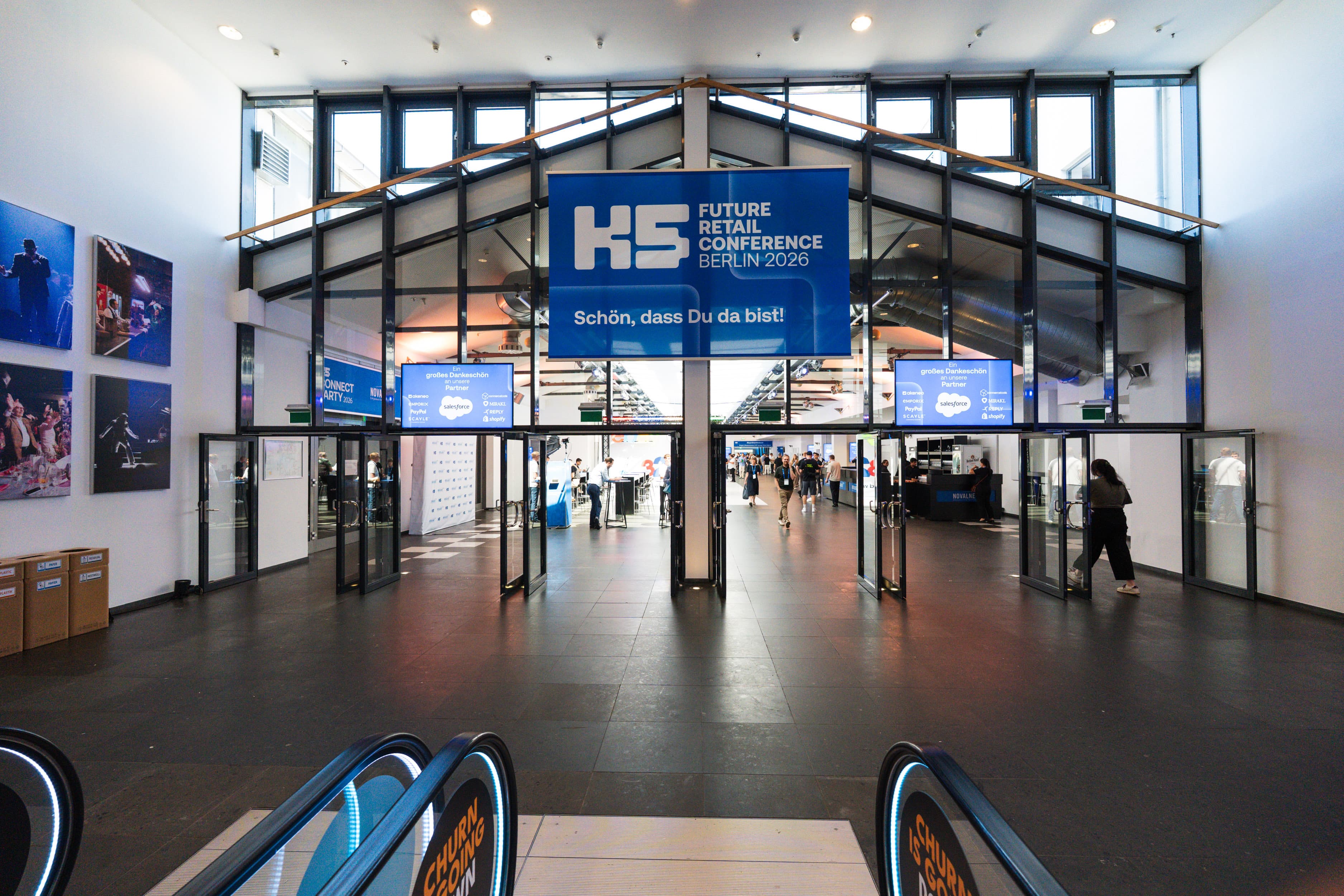
At K5 Future Retail 2026 in Berlin, the question stopped being whether to use AI in e-commerce and became whether anything in e-commerce still runs without it. Across two days at the Estrel Berlin — 23 and 24 June — more than 5,000 decision-makers, 200-plus exhibitors and over 250 speakers worked through six headline themes: AI and automation, social and live commerce, China and Asia, retail media, logistics, and growth. AI was not one of the six themes. It sat underneath all of them.
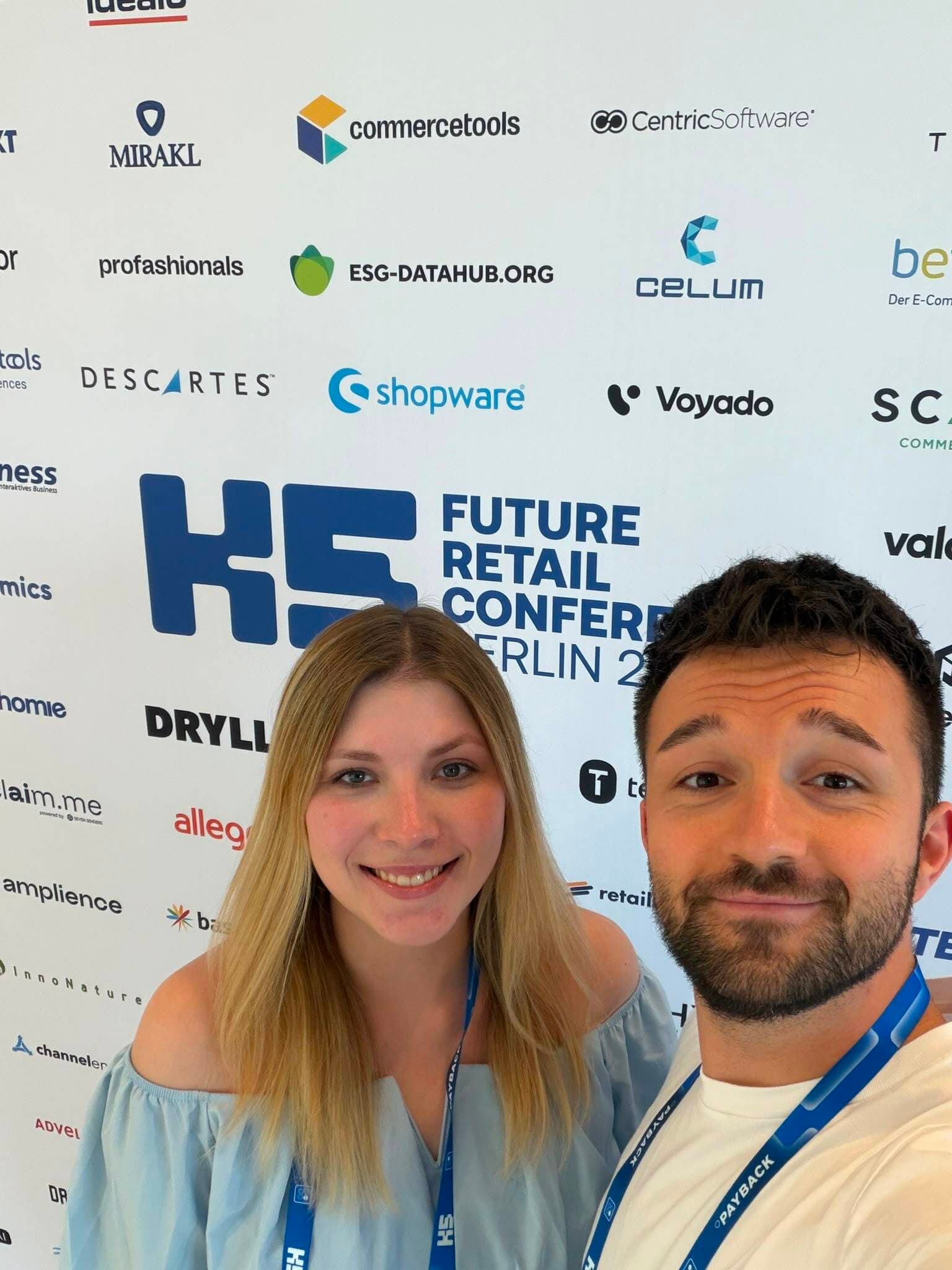
nonplusultra had two people on the floor for all of it. Vivien Pannier and Dominik Hack represented us at K5 — in the sessions, in the expo halls, and in the conversations between them, which is where the most useful insight of the event actually surfaced. What follows is what they brought back, and more importantly, what it changes for a consumer-electronics brand trying to win shelf space and search visibility across EMEA.
AI Was on Every Stage at K5 — Because It Stopped Being a Channel
K5 added a dedicated AI stage this year, alongside its two main stages and three expo stages. The programming itself was the signal: AI no longer fits inside one track because it now runs through every track — merchandising, search, fulfilment, service and content all had an AI answer attached.
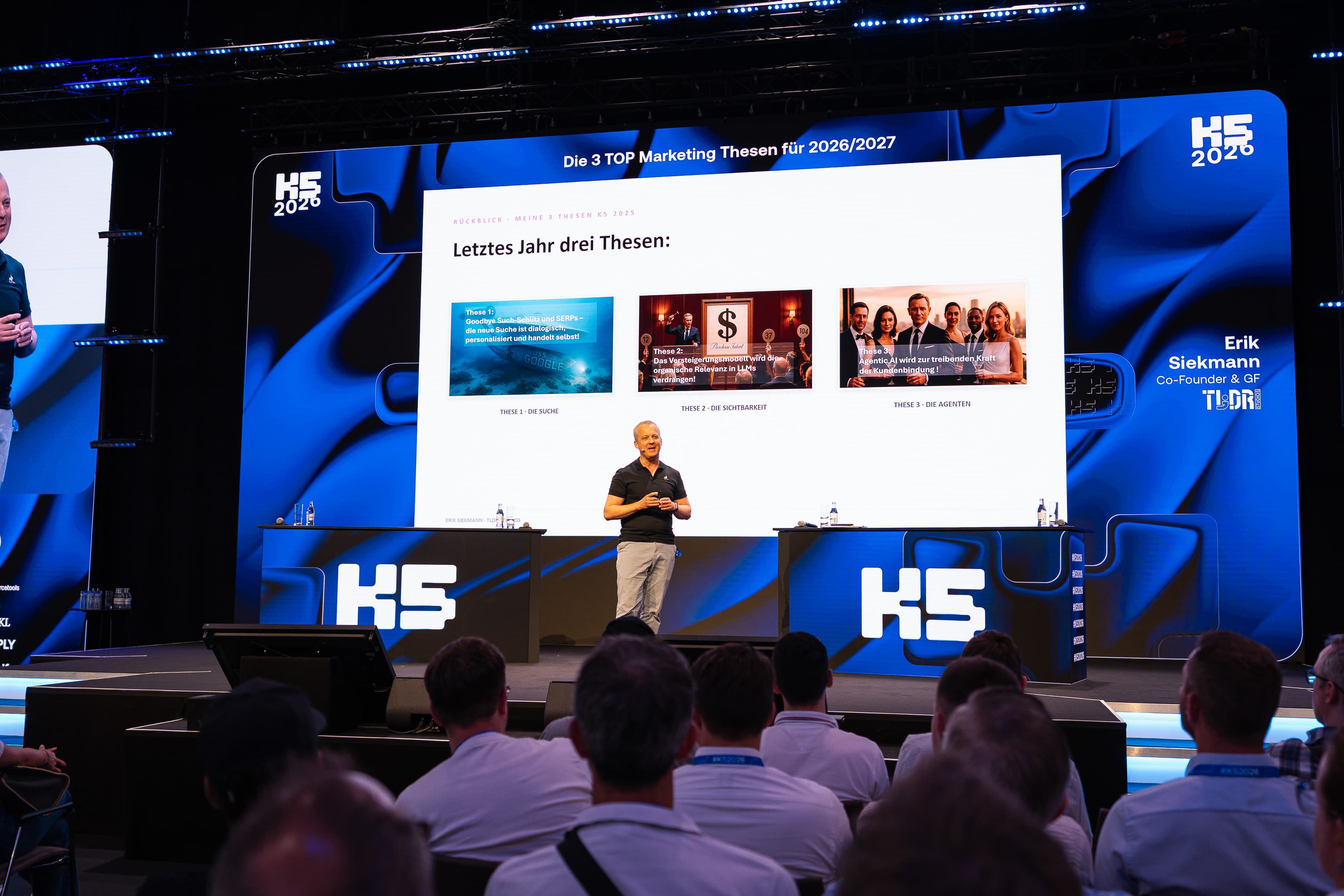
The sharpest version came from Erik Siekmann, Co-Founder and Managing Director of TL;DR, who used his K5 2026 keynote to lay out three theses for 2026 and 2027. First: the search slot and the classic results page are going away — search is becoming dialogic, personalised, and increasingly able to act on its own. Second: the auction logic that defined paid search will start to displace organic relevance inside large language models. Third: agentic AI will become a driving force of customer retention, not just discovery.
Read alongside the hard numbers, the direction is unambiguous. Nevin Francis, Senior VP at NielsenIQ, has shown AI-driven product search climbing from roughly 10% of European product-discovery touchpoints in 2025 toward a projected 22% by the end of 2026. Put Siekmann's theses and that curve together and the implication for a tech brand is concrete: discovery is shifting from "rank on Google and win the marketplace search box" to "be legible to a model that answers on the buyer's behalf." The input to that model is your product data.
Customer Centricity Is No Longer Enough — Brandt's Warning to Brands
If Siekmann described the engine, Jan Niclas Brandt described the road. The CCO of CECONOMY — the parent company of MediaMarktSaturn — opened his K5 keynote with a deliberately provocative line: customer centricity is no longer enough. Customers, he argued, think in moments, not in channels or touchpoints, and customer context has to flow across the entire journey or it breaks.
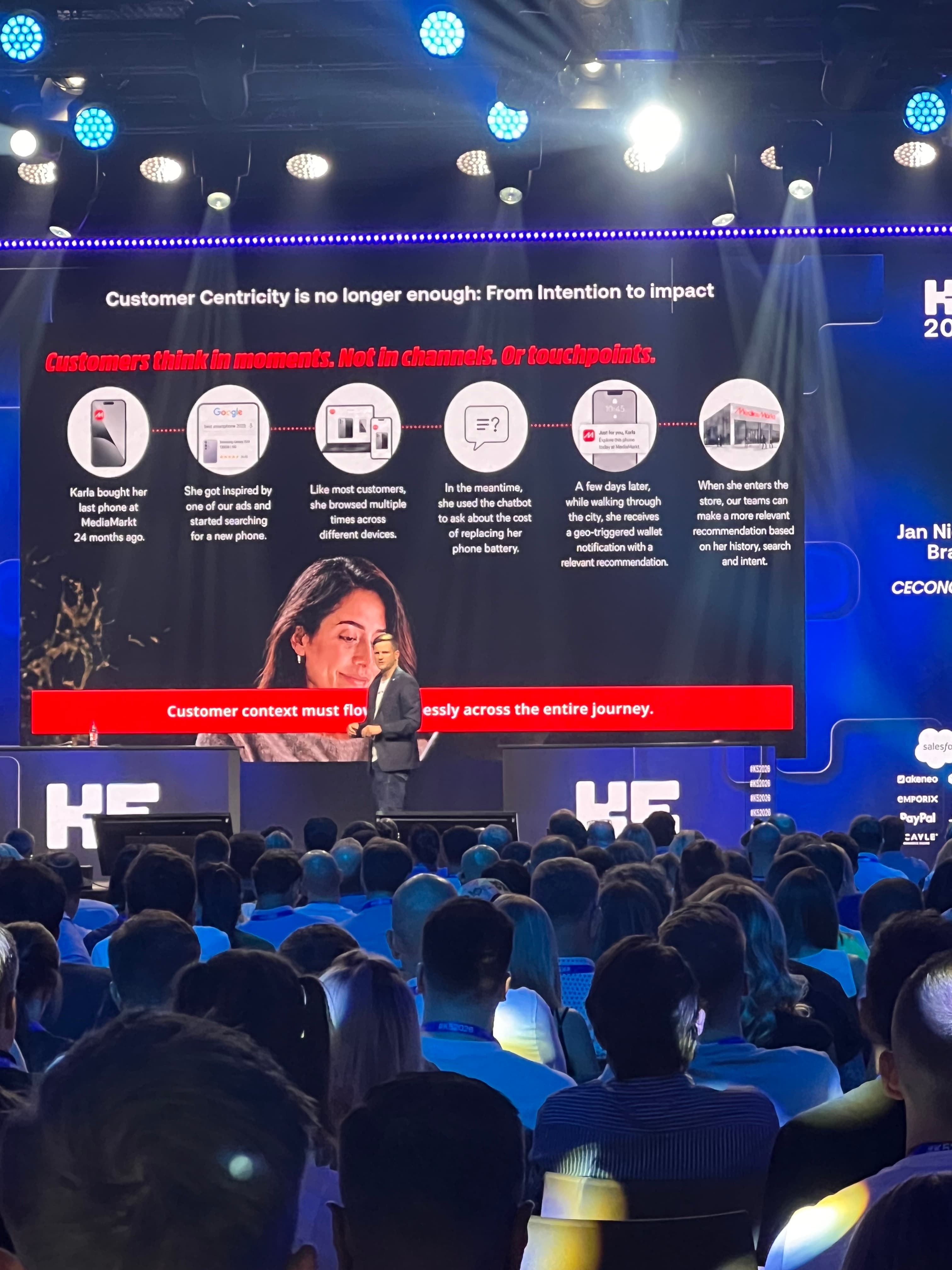
His example was a MediaMarkt shopper named Karla: she bought her last phone in store two years ago, gets inspired by an ad, searches across several devices, asks a chatbot about a battery replacement, receives a geo-triggered wallet notification days later, and finally walks into a store where staff can make a genuinely relevant recommendation based on her history and intent. Every step in that chain is a data-handoff problem before it is a marketing problem. For a brand sitting on a MediaMarkt shelf, the lesson is direct: the retailer is already building this connected picture of the shopper, and the brands that feed it clean product and availability data are the ones that show up at the relevant moment.
Social Commerce Is Rewiring the Journey — and Tech Brands Are Late
Social and live commerce had its own main track, and the framing has matured past "should we be on TikTok." The discovery-to-purchase loop now closes inside the social app itself, and the tempo is set largely by Chinese platforms that treat demand creation as a core competence rather than a campaign.
This is where we see a consistent gap from the field. A brand will fund a social presence as awareness spend, measured on impressions, while the actual transaction, the review and the repeat purchase happen on a surface the brand neither staffs nor merchandises. In a German MediaMarkt aisle, no serious brand would leave the shelf unmanaged and call it marketing. The social storefront has earned the same discipline, and most consumer-electronics brands have not yet organised for it.
From the Shelf: AI Discovery Starts With Product Data, Not Ad Spend
Here is the throughline that connects every AI stage at K5 to a physical aisle in Germany, and it is the part I will put our name behind. The brands that win AI-mediated discovery will not be the ones spending the most. They will be the ones whose product data is clean enough for a machine to summarise correctly: structured attributes, accurate category framing, rich descriptions, usable image metadata.
We see the identical failure mode in two places at once — in the online marketplace catalogue and on the physical shelf. A brand leads with a spec dump where the buyer, human or AI, needs a structured answer to a specific question. The store associate cannot recommend it for the right use case, and neither can the model. Same root cause, two surfaces. This is the unglamorous work that decides AI visibility, and it sits upstream of any media budget. A brand cannot buy its way to being well-summarised. It has to be well-structured first.
The Most-Repeated Insight at K5 Wasn't About AI at All
For all the AI on stage, the takeaway our team brought back most often was the oldest one in the industry: the best ideas still come from a real conversation with someone who has done the work. Five thousand people in one building for two days is not a content-delivery mechanism — it is a relationship-density event. The brands that get the most out of K5 are not the ones who watch the most sessions. They are the ones who leave with three conversations worth continuing.

What EMEA Tech Brands Should Do With This
▸Audit your product data for AI readability before your next retail or marketplace push. Structured attributes, accurate category framing and image metadata now matter as much as your spec sheet — a model cannot recommend what it cannot parse.
▸Treat your social storefront like a managed shelf, not a media line. If TikTok Shop or live commerce closes the loop for your category, give it ownership, merchandising and a service standard — the way you would a key retail account.
▸Feed the retailer's connected customer picture. Brandt's "moments, not channels" is already operational at MediaMarktSaturn; the brands supplying clean product and availability data are the ones that surface at the relevant moment.
▸Benchmark your platform presence against the Chinese operators, not your Western peers. They reset the standard for demand creation; matching the brand down the hall is no longer the bar.
If you want to understand how your brand's product data actually performs in AI-driven search — and what to fix before your next retail negotiation — that is exactly what our Data Science service is built to answer. For how this plays out across marketplaces specifically, see Amazon & Marketplace Management; and for what disciplined EMEA execution has delivered in practice, the Shokz case study is a good place to start.